
One- or two-channel options
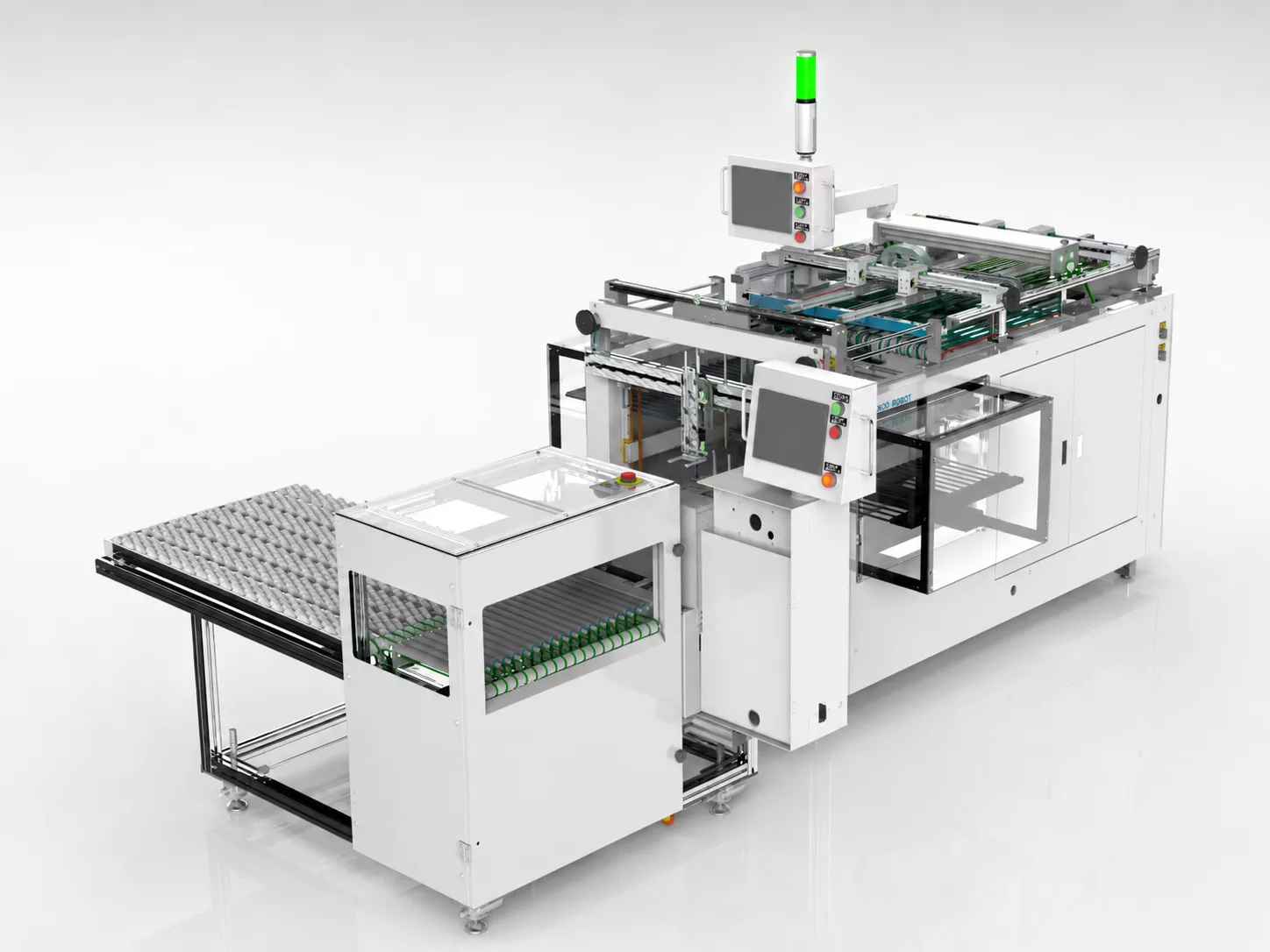
Middle-sealed Pouch Sorting and Binding Machine
Documented models: CK-LD-ZF-BZ-1 (Standard) / CK-LD-ZF-DX-1 (Guided Rejection)
Automatic sorting, stacking and strapping for center-sealed and related pouch formats.
Available configurations
Choose from the listed versions.
011-channel Standard
Model CK-LD-ZF-BZ-1. Sorts and stacks qualified pouches; this version has no defective-pouch rejection.
021-channel Guided Rejection
Model CK-LD-ZF-DX-1. Guided Rejection means Bundle Automatic Rejection: when the connected detection system identifies a defective pouch, the mechanism pushes the entire affected row sideways into a rejection chute and collection box. Good pouches in that row are rejected too.
032-channel Standard
Standard sorting without defective-pouch rejection. The supplied model list does not identify a separate two-channel model code; please confirm before ordering.
042-channel Guided Rejection
Guided Rejection means Bundle Automatic Rejection: the entire affected row is pushed sideways into a rejection chute and collection box, including any good pouches in that row. The supplied model list does not identify a separate two-channel model code; please confirm before ordering.
The documented middle-sealed models are CK-LD-ZF-BZ-1 (Standard) and CK-LD-ZF-DX-1 (Guided Rejection). Standard versions do not reject defective pouches; whole-row ejection applies only to Guided Rejection configurations. The published machine-specific maximum is 120 cuts/min. The general rejection-mode ceiling of 300 cuts/min does not replace this machine's rating. Confirm two-channel model codes and specifications before ordering.
Specification
The details that
shape your line.
Four-side sealed, pet food, rice, center-sealed gusseted and center-sealed two-channel pouches.
Maximum values and compatibility depend on the selected configuration, pouch material and production conditions.
| Model | CK-LD-ZF-BZ-1 (Standard); CK-LD-ZF-DX-1 (Guided Rejection) |
|---|---|
| Power supply | AC220V / 50Hz |
| Operating noise | ≤75 dB |
| Machine weight | Approx. 300 kg |
| Discharge mode | Horizontal output |
| Standard channel | 1 |
| Maximum linear speed | 50 m/min · 120 cuts/min |
| Applicable pouch size | Min. 70 × 140 — Max. 160 × 300 mm |
| Maximum stack height per bundle | ≤125 mm |
| Applicable pouch type | Four-side sealed, pet food, rice, center-sealed gusseted and center-sealed two-channel pouches |
| Machine dimensions | L2880 × W1750 × H1506 mm |
| Applicable pouch thickness | ≥0.15 mm (double-layer) |
Capabilities
Designed around the finishing task.
Multiple pouch formats
Suitable for four-side sealed, pet food, rice, center-sealed gusseted and center-sealed two-channel pouches.
Four listed configurations
The listed choices cover one- and two-channel Standard or Guided Rejection configurations. Two-channel model codes and final specifications require confirmation; six-version or single-pouch precision configurations are not documented for this machine.
Third-party signal compatibility
Guided Rejection configurations receive a switching signal from compatible inspection equipment, including third-party vision or joint-inspection systems. Detectable defects depend on that inspection equipment; the rejection mechanism itself does not provide inspection. Confirm signal compatibility before ordering.
Bundle Automatic Rejection
On Guided Rejection configurations, the mechanism pushes the entire affected row sideways into a rejection chute and collection box. If only one pouch is defective, good pouches in that row are also rejected. Pouches in unaffected rows continue on the main conveyor.
Continuous production
Compatible with bag-making machines for continuous production.
Process overview
A clear sequence.
A connected workflow.
- 01
Normal conveying
Pouches are continuously fed into the detection area at a stable production rhythm. Standard configurations perform sorting and stacking without defective-pouch rejection.
- 02
Detect and trigger
For Guided Rejection, compatible inspection equipment identifies a non-conforming pouch and sends a rejection signal. Sorting and counting continue as part of the finishing workflow.
- 03
Sideways row ejection
The mechanism pushes the entire affected row sideways into the rejection chute and collection box, including good pouches sharing that row. This step does not apply to Standard configurations.
- 04
Continue to finishing
Pouches in unaffected rows continue along the main conveyor for stacking and strapping.
In detail
See the equipment.
See the finishing result.
Your next step